
On Responsibility, Boundaries and the Courage to Let Go
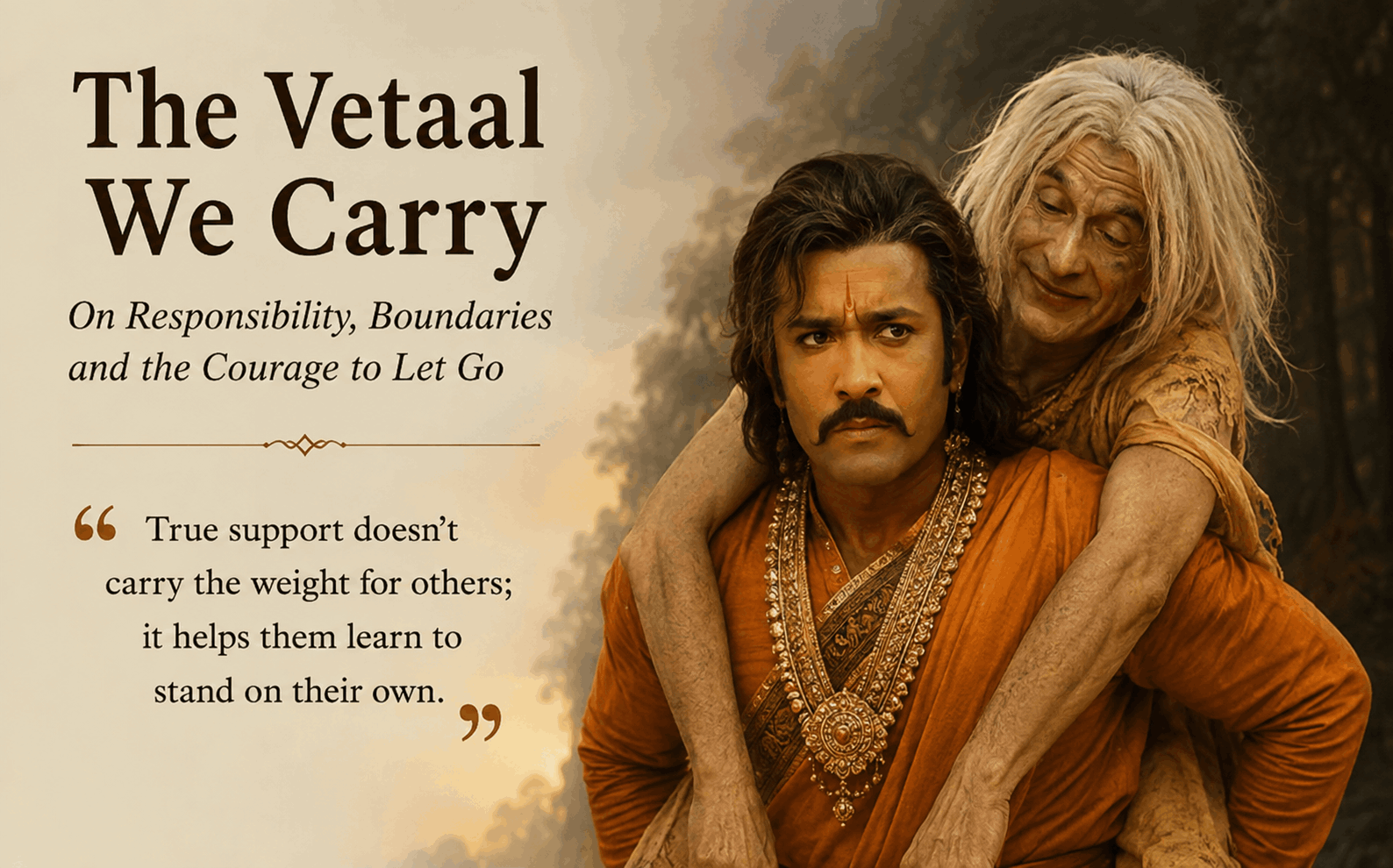
I was busy with something when I heard a familiar old title song playing somewhere in the distance.
Vikram… Vikram… Vikram… Vetaal… Vetaal… Vetaal… Vikram aur Vetaal…
And suddenly, I was back in the days when Doordarshan was our only source of visual entertainment. As children, we eagerly waited for the Sunday telecast. Arun Govil as King Vikram, Sajjan as Vetaal, and the many characters in the stories kept us glued to the screen.
The stories fascinated me then. Growing up, I began to see something deeper in them—stories about human behaviour, choices, dilemmas, responsibility and the consequences of our actions.
Lately, I have often felt like Raja Vikram, destined to carry Vetaal on his shoulders forever.
I carry the weight of relationships where I am taken for granted. I do work that colleagues should have completed. I bend over backwards to meet the expectations of elders. I rescue people who have been careless or irresponsible.
The load is often disguised as responsibility.
I tell myself: just a little more patience, a little more support, a little more effort from me—and perhaps this problem will finally be solved.
But it rarely is.
And that is when I began to wonder: Am I supporting people, or am I helping create their dependency on me?
When Helping Becomes Collusion
In human processes and organisational work, we often speak about dependency and interdependence. I have come to understand this distinction in a very personal way.
Sometimes one person keeps asking while another keeps giving. One avoids responsibility; the other quietly takes on more than is theirs to carry. What looks like care or support gradually becomes a pattern.
And I realised that I can be an active participant in creating that pattern.
Someone asks. I say yes.
Someone does not complete something. I step in.
Someone struggles. I solve the problem.
Each individual act may appear helpful. But repeated over time, it communicates something unintended: “You don’t have to take responsibility. I will.”
The helping then stops being developmental. It begins to prevent growth.
The question is not simply; How do I solve this problem? It is also: “What happens if I keep solving it for them?”
From Doing For to Doing With
Dependency itself is not the problem. Human beings need one another. Children need parents, colleagues need colleagues, ageing parents may need their children, and leaders need teams they can rely on.
The aspiration is not independence at all costs. It is interdependence—where people can depend on one another while retaining their agency.
Healthy interdependence shifts the relationship from doing for to doing with.
That can require surprisingly small behavioural shifts:

These are everyday choices that either strengthen or weaken agency.
Learning to Say No
For a long time, I found boundaries difficult.
I had learnt to say yes. Saying no felt almost like failing in my responsibility towards others. I did not always give myself permission to say, This is enough. This is not mine to carry.
But boundaries are not walls against relationships. They are what allow relationships to remain healthy.
They help us distinguish between supporting someone and carrying them. They also make room for people to grow—sometimes together, sometimes independently.
Perhaps the hardest lesson has been accepting that not every relationship will evolve into mutual interdependence. Some patterns remain stubbornly unchanged.
Looking back, I can see times when I have unconsciously played Vikram—carrying burdens that were not entirely mine. And I can also see other relationships with those very same people where we have created something wonderfully mutual.
That has taught me something important: dependency and interdependence are not fixed states. They exist on a spectrum, and we move between them constantly.
Which Vetaal Do We Carry?
I don’t aspire to absolute independence. I would feel isolated and incomplete if I had no relationships I could depend upon—or if nobody could depend upon me.
We are not meant to live that way.
The aspiration is to create relationships where support and responsibility flow in both directions; where care does not diminish agency; where asking for help does not mean surrendering responsibility; and where nobody has to carry the entire weight alone.
Perhaps this is what growing up is about—for individuals, families and organisations alike:
Learning which Vetaal to carry, which Vetaal to walk alongside, and which Vetaal to put down—gently, but firmly.
Because sometimes the most helpful thing we can do for another person is not to lift their burden onto our own shoulders.
It is to give them the opportunity to discover that they can carry it themselves.

Gauri Nigudkar
ISABS Professional member | Founder – G Consulting | OD Consultant
Gauri is an organisational consultant and human behaviour facilitator with over 25 years of experience working with leaders and teams. She thrives on diversity and is often chasing more than one pursuit. Her interests include creative writing, theatre and photography which she brings into her work as well.
Gauri believes in being in tune with one’s essence and practices that in her personal life as well.
Very well written and relevant for so many of us